What is an ALEKS Knowledge Check?
It is the assessment part of ALEKS, separate from the practice in your Learning Path. McGraw Hill’s student FAQ gives two purposes: “to determine exactly what students know at the time they complete it, and to identify topics students have previously mastered or learned that they haven’t demonstrated retention of.” There are four ways one starts:
| Kind | When it happens | What McGraw Hill says about it |
|---|---|---|
| Initial Knowledge Check | At the start of the course | The tour calls it “a personalized, adaptive assessment that includes approximately 25 to 30 questions.” Its result is your first ALEKS Pie. |
| Progress Knowledge Check | “At regular intervals” (the three triggers in the box above), or “after the completion due date of a Module” | Re-tests “recently learned and previously mastered topics” (student FAQ). |
| Goal Completion Knowledge Check | “The first time a student fully completes the Pie” | “Often, the student will score less than 100%.” Filling the pie a second time does not start another one (ALEKS FAQ). |
| Scheduled by your instructor | Whenever the instructor sets one | “Students are unable to request a Knowledge Check” themselves (ALEKS FAQ). |
When does ALEKS give a Progress Knowledge Check?
When you hit the first of three limits. McGraw Hill’s student FAQ lists them as:
- “After 20 topics are learned AND 5 hours are spent in learning mode”
- “After 10 hours are spent in learning mode”
- “After 60 days without a Knowledge Check, or after 30 days without a Knowledge Check for Higher Education Chemistry”
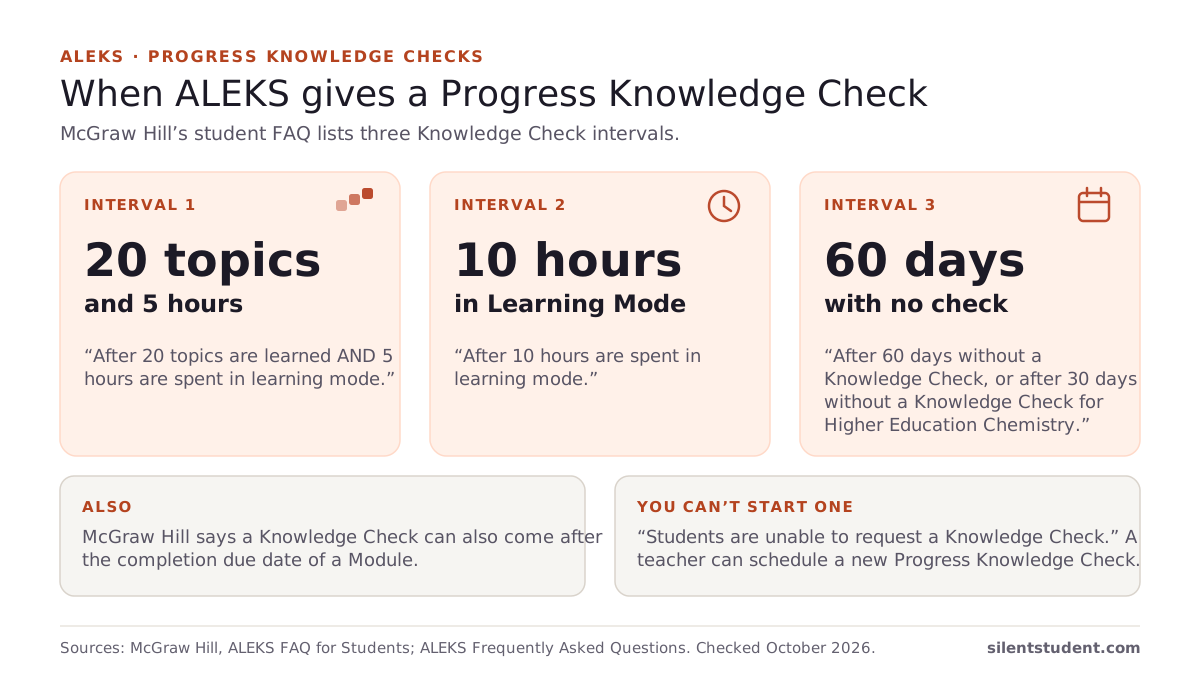
Here is how we read those rules, with made-up students. Someone who learns 20 topics in 4 hours has not met the first rule yet, because it needs both numbers, so the check arrives when their Learning Mode time reaches 5 hours. Someone who learns 12 topics in 10 hours gets one at the 10-hour mark under the second rule. Someone who stops logging in gets one after 60 days, or 30 in a higher-ed chemistry course. The same FAQ adds that a check can also come “after the completion due date of a Module.”
The practical point: a long study session can run into a Knowledge Check partway through, so leave time for one before a deadline.
How many questions are on an ALEKS Knowledge Check, and is it timed?
For the first one, about 25 to 30. ALEKS’s student tour says the Initial Knowledge Check “includes approximately 25 to 30 questions.” It is adaptive, so the questions you see depend on your earlier answers.
For later checks, McGraw Hill’s pages that we read give no question count and no time limit. We would rather say that than guess. Your instructor can see your course setup, so ask them if the length matters for your plans. If your class uses proctoring, McGraw Hill’s ALEKS remote proctoring page describes Respondus LockDown Browser, which aims to “prevent students from accessing other applications, copying, printing or visiting other sites,” and a Respondus Monitor start-up guide for students “before Knowledge Checks, quizzes or tests” that use it.
What does I Don’t Know do on an ALEKS Knowledge Check?
It tells ALEKS you can’t solve that problem, and ALEKS treats the topic as one you haven’t kept. McGraw Hill’s student FAQ says a topic can move out of Mastered or Learned when students show they haven’t retained it, “either by selecting I Don’t Know or by answering a related question incorrectly.” Its advice is to “try their best on Knowledge Checks and only choose I Don’t Know for problems they truly do not know how to solve.”
In our reading, that puts I Don’t Know and a wrong answer in the same place for the topic involved.
Why did my ALEKS pie go down after a Knowledge Check?
Because the check found topics you hadn’t retained, and ALEKS sent them back. The student FAQ says such a topic “may move from the Mastered or Learned category to the Remaining category, and be put back in the Learning Path to be learned again.” It adds that these topics, “and perhaps others that are linked to them,” return to the Topic Carousel.
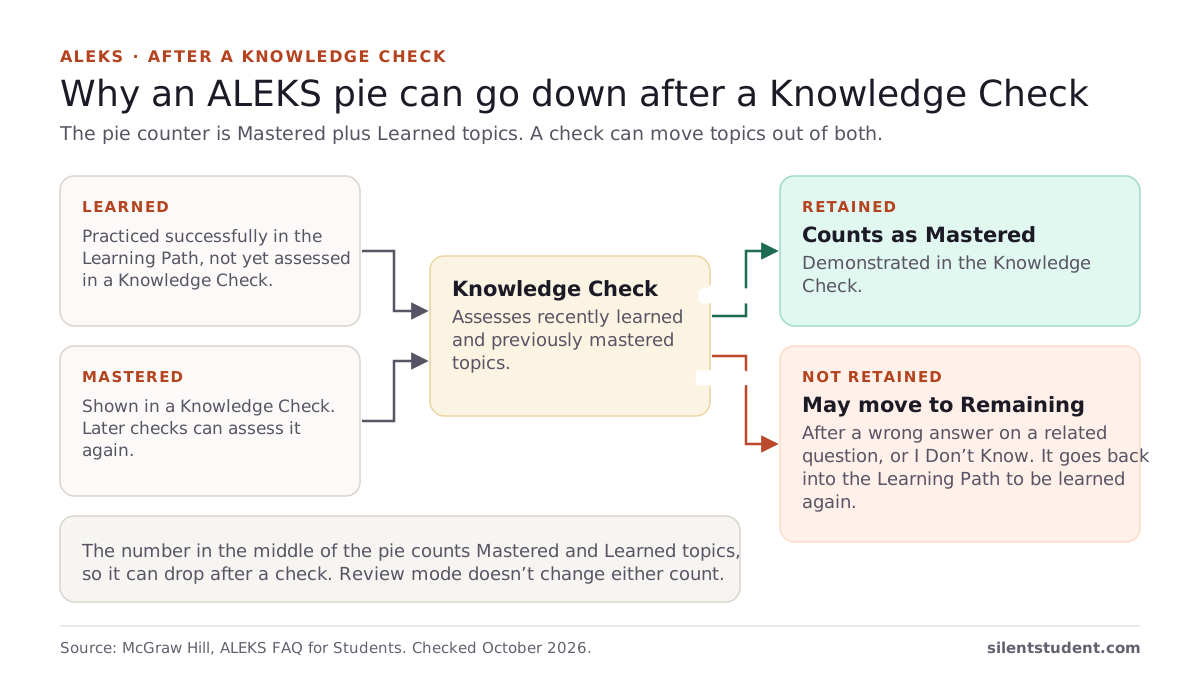
Two words on the pie matter here. McGraw Hill says “Mastered refers to the number of topics a student has demonstrated mastery of in a Knowledge Check,” while “Learned is the number of topics that a student has practiced successfully in the Learning Path but has not yet been assessed on through a Knowledge Check.” The number in the middle of the pie counts both.
| Illustration (not real data) | Mastered | Learned | Pie counter |
|---|---|---|---|
| Before the check | 50 | 30 | 80 |
| The check confirms 24 of the 30 learned topics and all 50 mastered ones | 74 | 0 | 74 |
In that made-up case the counter falls by 6 even though 24 topics were promoted from learned to mastered, because the 6 topics not retained go back to Remaining. A check can also ask about older mastered topics: McGraw Hill says “a Knowledge Check may assess students on topics they’ve demonstrated mastery of in past Knowledge Checks.” The table is our illustration of the definitions above, not a McGraw Hill example.
Can you retake or prepare for an ALEKS Knowledge Check?
You can’t start one yourself. McGraw Hill’s ALEKS FAQ says students “can reach out to their teachers to schedule a new Progress Knowledge Check.” The same FAQ lists reasons a teacher might schedule one, including if they are “worried that students may have received help on their last Knowledge Check.”
To prepare, ALEKS has Review. The student FAQ calls it “a safe environment for students to practice” that “does not affect their knowledge state or count of Mastered, Learned, or Remaining topics,” and recommends using it “especially before a Progress Knowledge Check.” Two limits: “The Review option will not be available during a Knowledge Check or while completing an assignment,” and after a new check ALEKS resets the review list from the new results.
After a Goal Completion Knowledge Check, you can fill the pie again. McGraw Hill says that “the second time the student fills in the pie chart, there will not be another Goal Completion Knowledge Check,” though “the instructor can assign additional knowledge checks if desired.”
Where Silent Student fits
We make Silent Student, a desktop app for Mac and Windows from El Dorado Ignition LLC that works through Canvas courses and the courseware they link to. On ALEKS it works Learning Mode topics with a general screen-reading agent, not a solver written for ALEKS, and it reports what it could not confirm.
- It does not take the Initial Knowledge Check, Progress or Goal Completion Knowledge Checks, PPL placement or proctored exams.
- It does not recognise a Knowledge Check. Because ALEKS can start one after 5 or 10 hours in Learning Mode, queue Learning Mode topics only and take every check yourself.
- We publish no ALEKS accuracy figure. It costs $11.99, $24.99 or $49.99 a month, with no free plan.
McGraw Hill’s Terms. McGraw Hill’s Terms of Use, last updated October 16, 2026, bar using or enabling any “AI agent” or “browser extension” to take actions in the services, “including but not limited to, to view, complete, answer, or submit any assessment, assignment, or other activity, unless otherwise authorized in writing by McGraw Hill.” In our reading, that reaches Silent Student. We are not lawyers. Your school’s academic-integrity policy also applies, and under our Terms you are responsible for both.
More: our ALEKS solver that leaves Knowledge Checks to you and Best AI for ALEKS, compared. If ALEKS is one category of a weighted class grade, the weighted grade calculator shows what your ALEKS score does to the total.
Questions people ask
How many questions are on the ALEKS Initial Knowledge Check?
About 25 to 30. ALEKS’s student tour says it “includes approximately 25 to 30 questions.” It is adaptive, so which questions you get depends on how you answer.
How often does ALEKS give Knowledge Checks?
McGraw Hill lists three triggers: after 20 topics are learned and 5 hours are spent in Learning Mode, after 10 hours in Learning Mode, or after 60 days without a Knowledge Check (30 days in Higher Education Chemistry). One can also come after a module’s completion due date.
Is there a time limit on an ALEKS Knowledge Check?
The McGraw Hill pages we checked on October 20, 2026 state no time limit and no question count for Progress Knowledge Checks. If your instructor uses Respondus LockDown Browser or Monitor, those settings apply. Ask your instructor about your course.
Does I Don’t Know count as a wrong answer in ALEKS?
For the topic involved it has the same effect. McGraw Hill says a topic can leave Mastered or Learned “either by selecting I Don’t Know or by answering a related question incorrectly,” and advises using it only for problems you truly can’t solve.
Can I ask ALEKS for a new Knowledge Check?
Not yourself. McGraw Hill says students are unable to request a Knowledge Check but can ask their teacher to schedule a new Progress Knowledge Check.
Can I use Review during an ALEKS Knowledge Check?
No. McGraw Hill says the Review option is not available during a Knowledge Check or while completing an assignment. Use it beforehand: it does not change your Mastered, Learned or Remaining counts.
Does Silent Student take ALEKS Knowledge Checks?
No. It does not take the Initial Knowledge Check, any later Knowledge Check, PPL placement or proctored exams, and it does not recognise a Knowledge Check, so queue Learning Mode topics only.
Sources
All fetched and checked October 20, 2026 unless a line says otherwise.
- ALEKS student tour (aleks.com)
- ALEKS FAQ for Students (McGraw Hill support; the page notes its first questions are for K-12 users)
- ALEKS Frequently Asked Questions (McGraw Hill support)
- ALEKS Math & Chemistry Remote Proctoring (McGraw Hill)
- McGraw Hill Terms of Use , last updated October 16, 2026
How this guide was made. We read each McGraw Hill and ALEKS page listed above on October 20, 2026 and quote them directly. Where we draw a conclusion they don’t state, such as the pie illustration, we say it is ours. We wrote the guide with AI assistance and checked each quote against its source.
Related guides: Is there an ALEKS answer key? · Does ALEKS have a calculator? · How is SmartBook graded? · All guides · ALEKS · Weighted grade calculator
Written by the company that makes Silent Student. Silent Student is not affiliated with or endorsed by McGraw Hill. ALEKS and McGraw Hill are trademarks of their owners.